Which Supplements Actually Support Thyroid Health? What to Know Before Taking Them
A Functional Nutritionist does everything a Functional Medicine Practitioner does, but takes it to a whole new level by incorporating “Restorative Medicine.” This is holistic approach to health by incorporating food, sleep, stress, fitness, and toxic environmental factors, in the effort to reduce the risk of chronic disease.Functional Nutritionists use a systems-oriented approach by reviewing behaviors that may contribute to long-term health problems. By looking at all of these components, the functional nutritionist can use science, clinical expertise, and nutrition tools to encourage behavior modification and change to correct the root cause of the illness.
Functional Nutritionist Academy offers a fast track on-boarding step-by-step state of the art approach to becoming a Board Certified Functional Nutritionist.
For information go to : https://functionalnutritionistacademy.com
They provide an online board certification program accredited and recognized by the American Association of Drugless Practitioners (AADP) certification No. 17204112 and the International Certification and Accreditation Board.
The course also offers continuing education units (CEU’s) for Acupuncturists, Chiropracters and Naturopaths.
About the Author
Think of the word “restorative”. A Functional Nutritionist seeks to restore peak performance of all systems of the body using a holistic approach to health by restoring proper gut function; eliminating dysbiosis, poor digestion, addressing Leaky Gut, SIBO, Candida or other infections as well as Biofilms. Functional Nutritionists recognize that certain foods can disrupt gut function and cause inflammation; therefore, they incorporate “Therapeutic Diets”, and seek to reduce inflammation which can cause many illnesses.
They improve sleep hygiene, stress management, fitness, and reduce toxic environmental factors, all in an effort to reduce the risk of chronic disease. They balance hormones with natural approaches, reducing the risk of cancer. Hormones include thyroid, adrenal, and endocrine (sex) hormones. They improve brain function through diet and lifestyle changes. They use epigenetics and genetic testing to avoid triggering gene expression, so their client will know what foods to avoid, or which are best , what medicines may be harmful, what nutritional supplements will help, what exercises are best incorporated all based on their genes.
Functional Nutritionist use a systems –oriented approach while recognizing the web-like connections between systems and reviewing behaviors that may contribute to long-term health problems. By looking at all of these components, the Functional Nutritionist can use science, Functional laboratory Tests, clinical expertise, and nutrition tools to bring back proper function of all systems of the body to peak performance, encourage behavior modification and change to correct the root (underlying) cause of the illness, which often has a root in poor diet, the wrong diet and poor lifestyle choices.
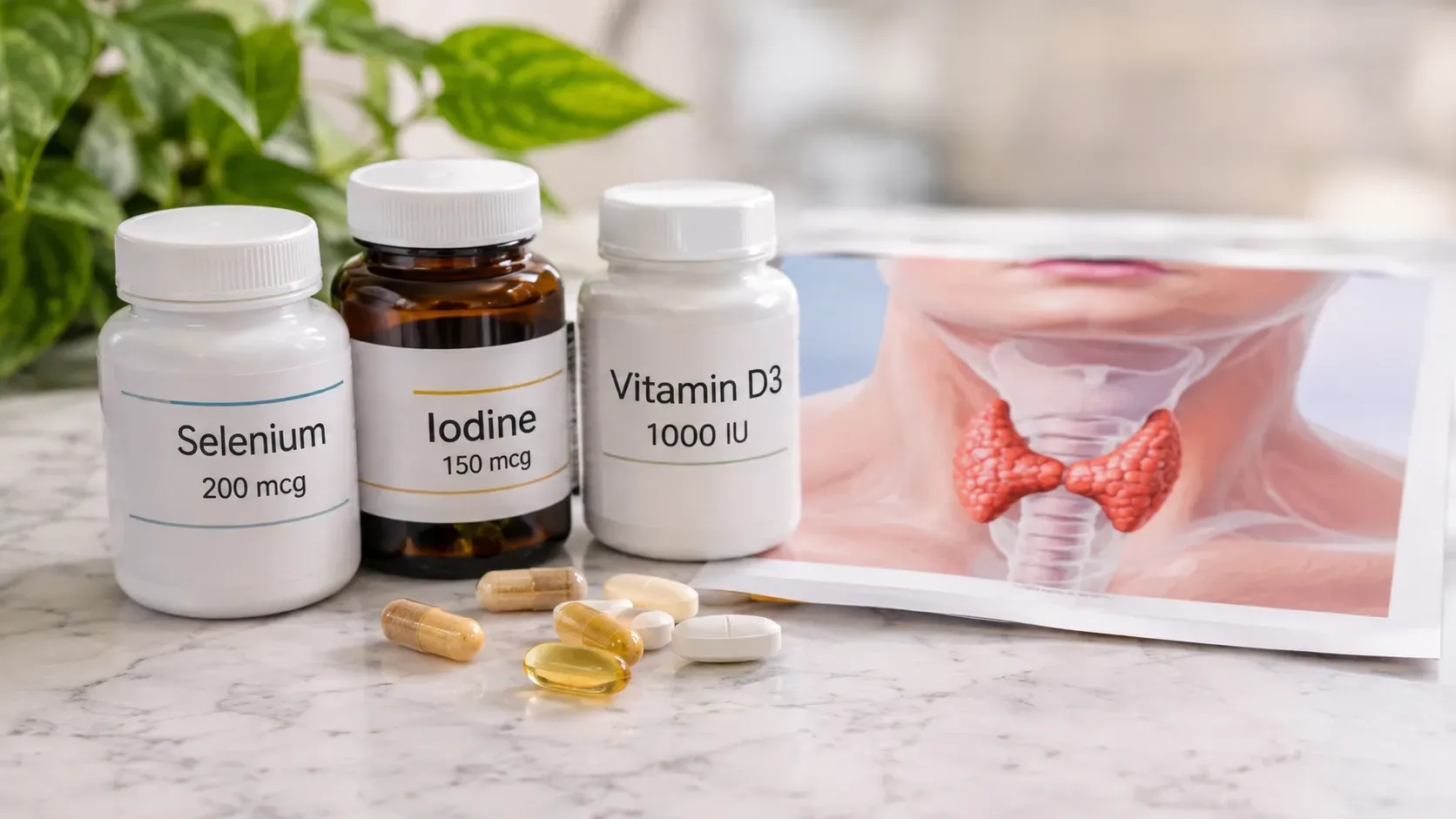
Table of Contents
- What Thyroid Health Supplements Can and Cannot Do
- Why Iodine Is the One to Be Careful With
- Selenium, Zinc and Vitamin D: What They Do
- More Is Not Better With Thyroid Nutrients
- If You Take Thyroid Medication, Start Here
- How to Decide Whether You Need Supplements at All
- Conclusion
- Talk to Us About Testing First
- Health and Supplement Disclaimer
- Frequently Asked Questions
Key Takeaways
- No supplement treats a thyroid condition or replaces thyroid medication.
- Iodine is the one where too much causes problems as readily as too little.
- "Low vitamin D is seen alongside" is not the same as "low vitamin D causes."
- Several supplements change how well thyroid medication is absorbed.
- Test first, correct the specific gap, retest. Not a blend bought on a hunch.
Introduction
Thyroid health supplements do not treat thyroid conditions, and the nutrients that genuinely matter to thyroid physiology are ones most people already get from a varied diet, which is why functional lab testing and a conversation with your own clinician belong before anything you put in a shopping basket.
That is a less satisfying answer than a bottle labeled "thyroid support." It is also the one that keeps people out of trouble, and thyroid is an area where trouble is genuinely possible.
What Thyroid Health Supplements Can and Cannot Do
Worth separating two very different things.
What a nutrient can do: your thyroid builds hormones out of raw materials, and a handful of nutrients are part of that machinery. If you are genuinely short of one of them, correcting that shortfall matters. That is real.
What it cannot do: if you are not short, adding more does not make the machinery run better. Topping up a full tank does not give you extra range.
And a clear boundary. Supplements do not treat Hashimoto's, Graves' disease, hypothyroidism or hyperthyroidism, and they do not replace thyroid medication. Those are medical conditions diagnosed with blood tests and managed by a clinician.
There is a reason self-directing this goes wrong so often. The symptoms people associate with thyroid trouble, fatigue, weight change, feeling cold, hair and skin changes, low mood, overlap with dozens of unrelated causes. Matching your symptoms to a list online and buying accordingly means treating a guess.
One more thing worth knowing before you shop: dietary supplements are not reviewed by the FDA for effectiveness before they are sold. A label claiming to support thyroid health has not cleared any bar on the way to the shelf.
Why Iodine Is the One to Be Careful With
If you take one thing from this article, take this one.
Iodine is a raw material for thyroid hormone. There is no arguing with its importance, and iodine deficiency remains a genuine cause of thyroid disease in parts of the world where intake is low.
Here is what supplement marketing tends to leave out. Too much iodine causes thyroid problems too, and it can push in either direction. Excess intake can contribute to an underactive thyroid in some people and trigger an overactive one in others. People with autoimmune thyroid conditions can be particularly sensitive to it.
So iodine is not a "might as well take it" nutrient. It is close to the opposite: a nutrient where the relationship between dose and effect is not a straight line, and where guessing has real consequences in both directions.
Two practical notes:
- Kelp and seaweed supplements can carry large and variable amounts of iodine, and the amount is not always well characterized on the label.
- Pregnancy changes the picture. Iodine requirements shift during pregnancy and while breastfeeding, which makes this a conversation for your obstetric provider rather than something to work out from an article.
We are not publishing amounts here. Whether you need iodine, and how much, depends on your intake, your test results and your diagnosis. That is a clinician's call made with data, not a shopping decision.
Selenium, Zinc and Vitamin D: What They Do
Described as physiology, which is what it is, rather than as a promise.
Selenium is required by the enzymes that convert T4 into the more active T3, and it is part of the antioxidant system that protects thyroid tissue during hormone production. Brazil nuts are a famously concentrated food source, and famously variable, since the amount depends on the soil the tree grew in.
Zinc is involved in thyroid hormone metabolism and in the receptor machinery that lets the body respond to it. Outright deficiency is uncommon on a varied diet, and more plausible with heavily restricted eating patterns, malabsorption, or after certain surgeries.
Vitamin D is the one most often misread. Low vitamin D levels are frequently observed in people with autoimmune thyroid conditions. Observed alongside is not the same as causing, and that distinction is exactly where a lot of supplement content quietly overreaches. Vitamin D is worth testing because it is commonly low for reasons that have nothing to do with the thyroid, not because correcting it is a thyroid treatment.
Notice what none of those paragraphs says. None of them says a supplement will improve your thyroid function, because that is not a claim anyone can make about a person whose levels have not been measured.
More Is Not Better With Thyroid Nutrients
Several of these have meaningful upper limits, and the margin is narrower than people assume.
Selenium is the clearest example after iodine. The gap between an adequate intake and an excessive one is not large, and too much causes its own problems. It is not a nutrient to take casually alongside a food source already rich in it.
The practical risk is almost never one bottle. It is stacking. A multivitamin, a "thyroid support" blend, a separate mineral bought for something else, plus a food source, and nothing is adding up the total because each product was considered on its own.
Blends deserve particular attention:
- Some contain iodine, often without that being the headline
- Some contain animal-derived thyroid tissue, which is a different category of product entirely
- The only way to know what is in one is to read the full label, not the front of the bottle
Which leads to the single most useful thing you can do: bring the actual bottles to your appointment. Not a list written from memory, not a photo of the fronts. The bottles. Nobody can assess what you are taking from a description.
The same reading-the-label discipline applies to any product category, which we covered in more depth when looking at supplement quality for gut health.
If You Take Thyroid Medication, Start Here
This section is not optional and it is the reason this article exists in the form it does.
Thyroid medication is dosed precisely and adjusted against blood tests. Several common supplements interfere with how much of it your body actually absorbs, with calcium and iron being the best documented. That matters in a specific way: the dose in the bottle stops matching the dose that reaches you, while the label on the prescription says the same thing it always did.
The consequence is quiet. A supplement started in January may show up as an out-of-range test result in April, and the connection is easy to miss unless someone is looking for it.
So:
- Do not stop, change or adjust thyroid medication based on anything you read online, including this.
- Tell your prescriber about every supplement you take, including ones you consider too minor to mention.
- Ask specifically about timing relative to your medication. Separation intervals are a prescriber and pharmacist question, and the right answer depends on the medication and the supplement.
How to Decide Whether You Need Supplements at All
A sequence, rather than a shopping list.
- Get tested before buying anything. Thyroid panels and nutrient markers give you something to act on instead of a guess, and they give you a baseline to measure against later.
- Look at the diet first. Our own position in nutrition consultation work is that diet changes usually come first, and supplements may be suggested when food alone does not cover a need.
- If something is genuinely low, correct that specific thing. A targeted single nutrient beats a blend containing eleven things you did not need and one you did.
- Retest. Taking something indefinitely without ever checking whether it worked is how people end up on twelve products.
- Keep your prescriber in the loop throughout, especially if you take thyroid medication.
Who should not self-direct any of this: anyone pregnant, breastfeeding or trying to conceive; anyone taking thyroid medication; anyone with a diagnosed autoimmune thyroid condition; and anyone managing other conditions or medications where interactions are possible.
Conclusion
The honest version of thyroid health supplements is quieter than the marketing. A few nutrients are genuinely part of how your thyroid works, being short of one of them genuinely matters, and the only way to know whether that applies to you is to measure it. Iodine in particular is a nutrient to respect rather than to guess at. If you are already on thyroid medication, the most valuable thing you can do this week is not buy anything at all. It is to make a complete list of what you already take and hand it to the person managing your dose.
Talk to Us About Testing First
If you want to know what is actually going on rather than work from symptoms, start with testing. Complete Health Institute offers functional laboratory testing including thyroid panels, arranged with a consultation so results are reviewed with your history rather than handed over as numbers. Dr. Teresa Rispoli holds a Doctor of Clinical Nutrition (DCN) and is a licensed acupuncturist (L.Ac.), with 30 years in functional medicine and nutrition, and offers a one-hour virtual functional nutrition consultation. We are at 28247 Agoura Rd in Agoura Hills, serving Westlake Village, Calabasas, Thousand Oaks, Woodland Hills, Malibu, Newbury Park and Moorpark, with virtual consultations available more widely. Call (818) 707-3126 or book a consultation. This is an informational starting point, not a diagnosis, and not a recommendation or guarantee of a specific outcome.
Health and Supplement Disclaimer
This article is for general information only and is not medical advice. It is not intended to diagnose, treat, cure or prevent any disease. Statements about dietary supplements have not been evaluated by the Food and Drug Administration. Thyroid conditions require diagnosis and management by a qualified healthcare provider. Do not start, stop or change any supplement or medication, including thyroid medication, without speaking to the clinician who manages your care. If you are pregnant, breastfeeding, trying to conceive, taking prescription medication or managing a diagnosed condition, speak to your provider before making changes.
Frequently Asked Questions
Do thyroid supplements work?
No supplement treats a thyroid condition. Correcting a genuine nutrient shortfall can matter, but that depends on testing showing a shortfall. Supplements are not reviewed by the FDA for effectiveness before sale.
Should I take iodine for my thyroid?
Not without testing and clinical guidance. Too much iodine can cause thyroid problems as readily as too little, and people with autoimmune thyroid conditions can be especially sensitive to excess intake.
Does vitamin D affect thyroid function?
Low vitamin D is often observed alongside autoimmune thyroid conditions, but observed alongside is not the same as causing. It is worth testing, since levels are commonly low for unrelated reasons.
Can supplements interfere with thyroid medication?
Yes. Calcium and iron are the best documented for reducing absorption, which means less of your dose reaches you. Tell your prescriber about everything you take and ask about timing.
What should I do before buying a thyroid supplement?
Get tested, review your diet first, and bring every bottle you currently take to your appointment. Correct a specific measured gap rather than taking a blend chosen from symptoms.